

TL;DR:
- Local dive resorts in East Bali offer quick access to calm house reefs ideal for beginners.
- Expert local guides enhance safety and marine encounters through extensive site knowledge.
- Small group ratios improve individual attention, safety, and personalized diving experiences.
Choosing the right dive resort in Bali can feel overwhelming. There are dozens of options scattered across the island, from busy tourist hubs in Kuta to quiet fishing villages in East Bali, and each promises an unforgettable underwater experience. But not all resorts are equal. Whether you are stepping into the ocean for the very first time or you already have a logbook full of dives, the resort you choose shapes everything: your safety, your skill development, the marine life you encounter, and honestly, how much fun you have. This guide breaks down exactly why local dive resorts in areas like Amed and Tulamben consistently deliver a richer, safer, and more personal experience for every type of diver.
Key Takeaways
| Point | Details |
|---|---|
| Ideal resort locations | Bali’s local dive resorts offer superb access to house reefs and beginner-friendly sites. |
| Expert guides improve safety | Local professionals and PADI programmes ensure international safety standards and enrich marine life spotting. |
| Personalised small group dives | Small group ratios mean more attention, safer learning, and tailored experiences for all skill levels. |
| Resorts outperform alternatives | Local resorts provide the best mix of easy access, comfort, safety, and adaptability for divers. |
| Avoid overlooked risks | Choosing a resort with local expertise helps mitigate currents and other hidden dangers. |
How proximity and house reefs maximise your diving adventure
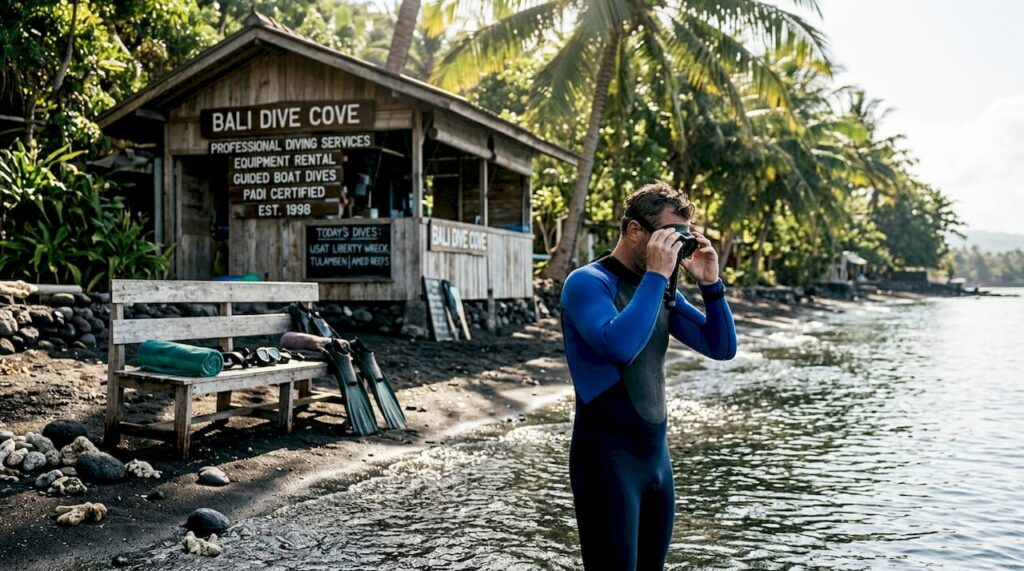
When people imagine diving in Bali, they often picture long boat rides to distant reefs. The reality at local resorts in East Bali is quite different, and far more appealing. Resorts based in Amed and Tulamben sit directly beside some of the island’s finest dive sites, meaning you can be underwater within minutes of pulling on your wetsuit.
Shore dives and house reefs in Amed and Tulamben reduce boat travel time significantly, making them ideal for beginners, and small group ratios of up to 4:1 improve both safety and the quality of learning. This matters enormously, especially if you are new to diving. Less time travelling means less fatigue, more dives per day, and more time absorbing everything your instructor teaches you.
Here is what this access genuinely means in practice:
- Flexible scheduling: Shore dives can happen at sunrise, midday, or dusk. You are not locked into a boat’s departure time.
- Multiple dives daily: With no long journeys, fitting in three or four dives in a single day is realistic and comfortable.
- Calmer entry conditions: East Bali’s sheltered bays offer gentle, predictable conditions, particularly well suited to novices building their confidence.
- Immediate instructor response: On a shore dive, your guide can signal and respond quickly, without the logistical delays of a boat setting.
The house reefs themselves are a treasure trove. Amed’s volcanic black sand slopes are home to vibrant corals, nudibranchs, ghost pipefish, and the occasional bumphead parrotfish cruising past in formation. You do not need to travel far at all to witness genuinely spectacular marine life.
| Feature | Shore and house reef diving | Long-boat dive trips |
|---|---|---|
| Travel time to site | Under 5 minutes | 30 to 90 minutes |
| Daily dive potential | 3 to 4 dives | 1 to 2 dives |
| Entry conditions | Calm, sheltered | Variable, weather dependent |
| Suitable for beginners | Yes | Often less so |
| Marine life variety | High, especially macro | High, but site dependent |
Pro Tip: If you are a first-time diver or working through your PADI Open Water course, ask your resort about early morning shore dives. Visibility tends to be at its best before the wind picks up, and the reefs feel wonderfully quiet at that hour.
With location established as a key factor, it is equally important to explore how local expertise further shapes your experience below the surface.
The safety and skill benefits of expert local guides
Knowing a dive site from a map is one thing. Knowing it because you have dived it hundreds of times, in every season, in all kinds of conditions, is something else entirely. Local guides at resorts in Amed carry that lived knowledge, and it makes a real difference to both your safety and your enjoyment.
On-site PADI certification programmes ensure international standards are maintained, and expert local guides elevate the experience further by enhancing safety and improving marine life encounters at iconic sites such as the USAT Liberty wreck in Tulamben. This is not just a selling point; it is a measurable advantage that affects how much you learn and how safe you remain underwater.
“Booking with a PADI-certified local resort means your instructor is trained to the same global standard, but brings irreplaceable on-the-ground knowledge that no international chain can replicate.”
Here is what experienced local guides specifically offer:
- Current and tide knowledge: They know when conditions shift at each site and adjust the dive plan accordingly.
- Marine life expertise: A skilled guide spots the tiny pygmy seahorse on the fan coral that you would walk past ten times without noticing.
- Hazard awareness: From fishing lines to boat traffic, local guides identify risks that visiting divemasters simply would not be aware of.
- Communication clarity: Guides who work with small groups daily develop a precise, calm briefing style that genuinely reduces anxiety for nervous first-timers.
For certification, the step-by-step process with a local PADI instructor looks like this:
- Pool or confined water session: You practise essential skills like mask clearing and buoyancy in a controlled setting before heading out.
- Theory sessions: Knowledge development can be completed online in advance, saving valuable in-water time on holiday.
- Open water dives: You complete your qualifying dives directly on Amed’s reefs, so your certification dives are also genuinely memorable experiences.
- Debrief and feedback: Local instructors take time after each dive to discuss what went well and what to improve, because small groups make this genuinely possible.
Explore guided dives in Bali to understand how expert-led experiences differ from joining a generic group tour. The contrast is significant. Being part of a Bali dive community rooted in local knowledge also means you benefit from years of collective experience that large operations simply cannot match.
Small group diving: personalised learning and comfort
Group size is one of the most underrated factors when choosing a dive resort. It directly affects how much attention you receive, how safe you feel, and how quickly you progress. At local resorts in East Bali, small groups are not a marketing promise. They are a structural part of how diving is run.

Small groups of up to 4:1 mean your guide can genuinely focus on each individual, catching issues before they become problems and spotting marine life that a crowd would scare away. For beginners in particular, this ratio transforms learning. You are not keeping up with strangers; you are progressing at your own pace with an instructor who actually knows your name.
It is also worth noting an important edge case. Strong currents at sites like Nusa Penida require certified, experienced divers; local resorts in calmer East Bali are far better suited for beginners and those still building confidence. Not every site in Bali is appropriate for every diver, and a responsible local resort will always match you to conditions that suit your current skill level.
| Experience level | Ideal site | Group size | Conditions |
|---|---|---|---|
| Complete beginner | Amed house reef | Up to 4:1 | Calm, shallow |
| Open Water certified | USAT Liberty wreck | Up to 4:1 | Moderate, manageable |
| Advanced certified | Nusa Penida (Crystal Bay) | Smaller groups recommended | Strong currents possible |
| Experienced diver | Multiple East Bali sites | Flexible | Varied, guide-dependent |
The social dimension of small group diving is also worth celebrating. You will likely end up sharing surface intervals, dive stories, and marine life discoveries with two or three other divers who become proper companions by the end of the trip. That kind of shared experience is hard to replicate in a group of twenty.
Pro Tip: When booking group dives in Bali, always ask about the maximum group size. If a resort cannot give you a clear, specific answer, that tells you something important about how they operate.
Local dive resorts vs. alternative options: a head-to-head comparison
It is worth being honest about the alternatives. Larger dive operations, day-trip boat tours, and independent diving all have their place, but they come with trade-offs that matter considerably in Bali’s variable conditions.
Larger operations often have bigger group sizes, standardised itineraries, and less flexibility when conditions change. Strong currents at exposed sites like Nusa Penida have caught inexperienced divers off guard when they have been placed in inappropriate conditions by operators who prioritise throughput over individual suitability. Local resorts in calmer east Bali simply do not take those risks.
Independent diving, while appealing to very experienced divers, removes the safety net of local knowledge and guide support entirely. Bali’s conditions can change quickly, and even seasoned divers benefit from a guide who knows where the thermoclines drop and which corners of a wreck are safe to enter.
Key advantages of local dive resorts at a glance:
- Personalised dive planning based on your experience level
- Expert guides with deep site-specific knowledge
- Small group ratios maintained consistently
- Flexible scheduling around tidal and current conditions
- On-site PADI training to internationally recognised standards
- Immediate access to house reefs without lengthy boat journeys
| Factor | Local dive resort | Large tour operator | Independent diving |
|---|---|---|---|
| Group size | Small (up to 4:1) | Often 8 to 12 per guide | None |
| Local expertise | Deep, site-specific | Variable | None |
| Safety oversight | High, personalised | Moderate | Self-managed |
| Flexibility | High | Low | High |
| Suitability for beginners | Excellent | Mixed | Not recommended |
| PADI certification | On-site | Sometimes available | Not applicable |
Statistic to consider: Dive industry research consistently shows that smaller group ratios are directly linked to improved safety outcomes and higher diver satisfaction scores, particularly among beginners completing their first open water dives.
Exploring beginner dive sites with a local resort means you get matched to appropriate conditions from day one, rather than finding yourself unexpectedly out of your depth, literally or figuratively.
The uncomfortable truth most experts won’t tell you about picking a Bali dive resort
Here is what we have observed after years of welcoming divers from all over the world to Amed. Most people make their resort choice based on convenience and price, and a surprising number end up with an experience that feels rushed, impersonal, or quietly unsafe.
The marketing from large dive operators is often very polished. It features stunning drone footage, glossy shots of manta rays, and promises of world-class instruction. But the reality of being diver number eleven in a group of twelve, waiting your turn while a guide juggles everyone’s needs, rarely matches those images. Understanding what a dive resort actually offers before you book is one of the most valuable steps you can take.
The deeper issue is that many travellers underestimate how much conditions vary around Bali. Strong currents at sites like Nusa Penida are not a minor consideration; they are a serious factor that makes certain sites genuinely unsuitable for novices. A resort driven by profit rather than safety will sometimes send you to a dramatic but inappropriate site because it looks impressive in the photos. A responsible local resort will tell you honestly when a site is not right for you.
Our perspective, shaped by more than sixteen years of combined diving experience in East Bali, is this: the best dive holiday you can have is not necessarily the one with the most dramatic sites or the biggest marketing budget behind it. It is the one where someone who genuinely knows these waters looks after you, adjusts the plan when the current shifts, and takes the time to show you the tiny frogfish sitting perfectly camouflaged on a piece of rubble at twelve metres. That is the kind of experience local expertise delivers consistently, and it is the kind you will still be talking about long after you have dried off and headed home.
Ready for Bali? Explore top dive resorts, courses and sites
Whether you are planning your very first underwater experience or you are a certified diver keen to explore East Bali’s wrecks and macro-rich reefs, Bali Dive Cove is here to make it happen. As a PADI 5-Star Dive Resort based in Amed, we keep groups small, communication clear, and every dive at your own comfortable pace.
Browse our full range of Bali dive courses for options from beginner Discover Scuba sessions through to advanced certifications. Ready to plan your time in the water? Our dive packages in Bali offer flexible combinations of guided dives and courses suited to all experience levels. And if you want to start dreaming about what awaits below the surface, explore our full guide to dive sites in Bali and discover what East Bali’s reefs, wrecks and slopes have in store for you.
Frequently asked questions
Which Bali dive resorts are best for beginners?
Resorts in Amed and Tulamben are ideal for beginners, thanks to calm house reefs with easy shore access and attentive expert guidance in small groups.
How do small group dives enhance safety?
Small group ratios of 4:1 allow guides to maintain close watch over each diver, catching problems early and making real-time adjustments that larger groups simply cannot accommodate.
Are PADI courses available at Bali’s local dive resorts?
Yes. Most reputable local resorts offer on-site PADI certification, ensuring your training meets globally recognised safety and skills standards, all within the setting of Bali’s actual reefs.
What should certified divers look for in Bali?
Sites like Nusa Penida can involve strong, unpredictable currents that require solid dive experience; always choose a resort whose guides assess your skills honestly and match you to appropriate conditions.
Is independent diving an option in Bali?
While technically possible for experienced divers, independent diving means losing the local knowledge, safety oversight, and marine life expertise that a qualified local guide brings to every dive.
